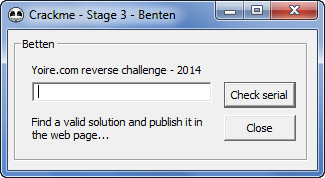
Aviso: Este crackme forma parte de una serie de pruebas de Yoire.com que todavía está en activo. Lo ético si continuas leyendo este manual es que no utilices la respuesta para completar la prueba sin esfuerzo. 😉

Analizando

Abrimos el crackme con Ollydbg y vamos a las referenced strings.
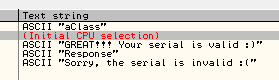
Pinchamos sobre cualquiera.

 

Vemos un «Call» donde seguramente se generará un SUM en función del serial metido ya que después del Call vemos una comprobación contra «B79E763E» lo que nos da una pista de que vamos a tener que utilizar fuerza bruta para llegar a ese valor. Vamos a explorar el Call.
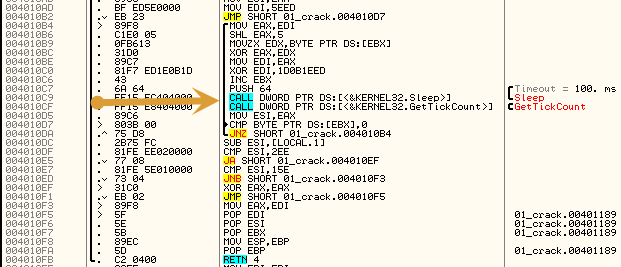
Lo que resalto con la flecha son una par de Calls que podemos NOPear ya que lo único que hacen es ralentizar la generación del SUM.
A continuación vamos a analizar el algoritmo de generación del SUM.
MOV EDI,5EED                   - EDI = 5EED
JMP SHORT 01_crack.004010D7
/MOV EAX,EDI                   <----Bucle
|SHL EAX,5                     - 5EED * 32 = BDDA0
|MOVZX EDX,BYTE PTR DS:[EBX]   - Coge el dígito
|XOR EAX,EDX                   - BDDA0 XOR digito
|MOV EDI,EAX
|XOR EDI,1D0B1EED              - XOR 1D0B1EED
|INC EBX
|..
|MOV ESI,EAX
CMP BYTE PTR DS:[EBX],0
JNZ SHORT 01_crack.004010B4   - Bucle ---->

Para un serial de tres dígitos la secuencia sería esta (valores en hexadecimal):

1º Digit —> BDDA0 XOR 1D0B1EED XOR 1ºDigit XOR 1D0B1EED = Temp
2º Digit —> Temp = Temp * 20 Xor 1D0B1EED XOR 2ºDigit
3º Digit —> Temp = Temp * 20 Xor 1D0B1EED XOR 3ºDigit

CMP Temp, B79E763E

Aplicando Fuerza Bruta

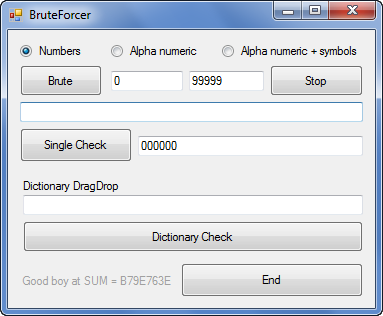
La creación del «BruteForcer» os la dejo a vosotros. Aquí teneis un fragmento hecho en VB.Net.

Dim temp As Long
Dim temp2 As String
Dim letter As Integer
Dim brute As String
brute = TextBox4.Text
temp = 0
temp = Asc(Mid(brute, 1, 1)) Xor 487268077 Xor 777632
temp2 = Hex(temp)
temp2 = Microsoft.VisualBasic.Right(temp2, 8)
temp = Convert.ToUInt64(temp2, 16)
For i = 2 To Len(brute)
letter = Asc(Mid(brute, i, 1))
temp = temp * 32
temp2 = Hex(temp)
temp2 = Microsoft.VisualBasic.Right(temp2, 8)
temp = Convert.ToUInt64(temp2, 16)
temp = temp Xor 487268077
temp2 = Hex(temp)
temp2 = Microsoft.VisualBasic.Right(temp2, 8)
temp = Convert.ToUInt64(temp2, 16)
temp = temp Xor letter
'
temp2 = Hex(temp)
Next
Links


Introducción Tal y como nos adelanta el creador está programado en .NET. Lo abrimos para ver su comportamiento y a
Intro We require your services once again. An employee from our company had recently been identified as a known criminal
Warning: This challenge is still active and therefore should not be resolved using this information. Aviso: Este reto sigue en
Introducción Hoy vamos a enfrentarnos a cuatro retos de esteganografía relativamente sencillos, y digo relativamente, debido a que hay tantas

Estamos ante un ELF un poco más interesante que los vistos anteriormente. Básicamente porque es divertido y fácil encontrar la solución en el decompilado y quizá por evocar recuerdos de tiempos pretéritos.

ELF Decompilado

/* This file was generated by the Hex-Rays decompiler version 8.4.0.240320.
   Copyright (c) 2007-2021 Hex-Rays <info@hex-rays.com>

   Detected compiler: GNU C++
*/

#include <defs.h>


//-------------------------------------------------------------------------
// Function declarations

__int64 (**init_proc())(void);
__int64 sub_400650(); // weak
// int printf(const char *format, ...);
// int puts(const char *s);
// void __noreturn exit(int status);
// size_t strlen(const char *s);
// __int64 __fastcall MD5(_QWORD, _QWORD, _QWORD); weak
// int sprintf(char *s, const char *format, ...);
// __int64 ptrace(enum __ptrace_request request, ...);
// __int64 strtol(const char *nptr, char **endptr, int base);
// __int64 __isoc99_scanf(const char *, ...); weak
// int memcmp(const void *s1, const void *s2, size_t n);
void __fastcall __noreturn start(__int64 a1, __int64 a2, void (*a3)(void));
void *sub_400730();
__int64 sub_400760();
void *sub_4007A0();
__int64 sub_4007D0();
void fini(void); // idb
void term_proc();
// int __fastcall _libc_start_main(int (__fastcall *main)(int, char **, char **), int argc, char **ubp_av, void (*init)(void), void (*fini)(void), void (*rtld_fini)(void), void *stack_end);
// __int64 _gmon_start__(void); weak

//-------------------------------------------------------------------------
// Data declarations

_UNKNOWN main;
_UNKNOWN init;
__int64 (__fastcall *funcs_400E29)() = &sub_4007D0; // weak
__int64 (__fastcall *off_601DF8)() = &sub_4007A0; // weak
__int64 (*qword_602010)(void) = NULL; // weak
char *off_602080 = "FLAG-%s\n"; // idb
char a7yq2hryrn5yJga[16] = "7Yq2hrYRn5Y`jga"; // weak
const char aO6uH[] = "(O6U,H\""; // idb
_UNKNOWN unk_6020B8; // weak
_UNKNOWN unk_6020C8; // weak
char byte_6020E0; // weak
char s1; // idb
char byte_602110[]; // weak
char byte_602120[33]; // weak
char byte_602141[7]; // idb
__int64 qword_602148; // weak
__int64 qword_602150; // weak
__int64 qword_602158; // weak
__int64 qword_602160; // weak
__int64 qword_602178; // weak


//----- (0000000000400630) ----------------------------------------------------
__int64 (**init_proc())(void)
{
  __int64 (**result)(void); // rax

  result = &_gmon_start__;
  if ( &_gmon_start__ )
    return (__int64 (**)(void))_gmon_start__();
  return result;
}
// 6021D8: using guessed type __int64 _gmon_start__(void);

//----- (0000000000400650) ----------------------------------------------------
__int64 sub_400650()
{
  return qword_602010();
}
// 400650: using guessed type __int64 sub_400650();
// 602010: using guessed type __int64 (*qword_602010)(void);

//----- (0000000000400700) ----------------------------------------------------
// positive sp value has been detected, the output may be wrong!
void __fastcall __noreturn start(__int64 a1, __int64 a2, void (*a3)(void))
{
  __int64 v3; // rax
  int v4; // esi
  __int64 v5; // [rsp-8h] [rbp-8h] BYREF
  char *retaddr; // [rsp+0h] [rbp+0h] BYREF

  v4 = v5;
  v5 = v3;
  _libc_start_main((int (__fastcall *)(int, char **, char **))main, v4, &retaddr, (void (*)(void))init, fini, a3, &v5);
  __halt();
}
// 400706: positive sp value 8 has been found
// 40070D: variable 'v3' is possibly undefined

//----- (0000000000400730) ----------------------------------------------------
void *sub_400730()
{
  return &unk_6020C8;
}

//----- (0000000000400760) ----------------------------------------------------
__int64 sub_400760()
{
  return 0LL;
}

//----- (00000000004007A0) ----------------------------------------------------
void *sub_4007A0()
{
  void *result; // rax

  if ( !byte_6020E0 )
  {
    result = sub_400730();
    byte_6020E0 = 1;
  }
  return result;
}
// 6020E0: using guessed type char byte_6020E0;

//----- (00000000004007D0) ----------------------------------------------------
__int64 sub_4007D0()
{
  return sub_400760();
}

//----- (00000000004007D7) ----------------------------------------------------
__int64 __fastcall main(int a1, char **a2, char **a3)
{
  size_t v3; // rax
  size_t v4; // rax
  int i; // [rsp+1Ch] [rbp-24h]
  int n; // [rsp+20h] [rbp-20h]
  int m; // [rsp+24h] [rbp-1Ch]
  int k; // [rsp+28h] [rbp-18h]
  int j; // [rsp+2Ch] [rbp-14h]

  if ( ptrace(PTRACE_TRACEME, 0LL, 0LL, 0LL) == -1 )
    goto LABEL_2;
  if ( a1 > 4 )
  {
    qword_602148 = strtol(a2[1], 0LL, 10);
    if ( qword_602148 )
    {
      qword_602150 = strtol(a2[2], 0LL, 10);
      if ( qword_602150 )
      {
        qword_602158 = strtol(a2[3], 0LL, 10);
        if ( qword_602158 )
        {
          qword_602160 = strtol(a2[4], 0LL, 10);
          if ( qword_602160 )
          {
            if ( -24 * qword_602148 - 18 * qword_602150 - 15 * qword_602158 - 12 * qword_602160 == -18393
              && 9 * qword_602158 + 18 * (qword_602150 + qword_602148) - 9 * qword_602160 == 4419
              && 4 * qword_602158 + 16 * qword_602148 + 12 * qword_602150 + 2 * qword_602160 == 7300
              && -6 * (qword_602150 + qword_602148) - 3 * qword_602158 - 11 * qword_602160 == -8613 )
            {
              qword_602178 = qword_602158 + qword_602150 * qword_602148 - qword_602160;
              sprintf(byte_602141, "%06x", qword_602178);
              v4 = strlen(byte_602141);
              MD5(byte_602141, v4, byte_602110);
              for ( i = 0; i <= 15; ++i )
                sprintf(&byte_602120[2 * i], "%02x", (unsigned __int8)byte_602110[i]);
              printf(off_602080, byte_602120);
              exit(0);
            }
          }
        }
      }
    }
LABEL_2:
    printf("password : ");
    __isoc99_scanf("%s", &s1);
    if ( strlen(&s1) > 0x10 )
    {
      puts("the password must be less than 16 character");
      exit(1);
    }
    for ( j = 0; j < strlen(&s1); ++j )
      *(&s1 + j) ^= 6u;
    if ( !strcmp(&s1, a7yq2hryrn5yJga) )
    {
      v3 = strlen(&s1);
      MD5(&s1, v3, byte_602110);
      for ( k = 0; k <= 15; ++k )
        sprintf(&byte_602120[2 * k], "%02x", (unsigned __int8)byte_602110[k]);
      printf(off_602080, byte_602120);
      exit(0);
    }
    puts("bad password!");
    exit(0);
  }
  printf("password : ");
  __isoc99_scanf("%s", &s1);
  if ( strlen(&s1) > 0x10 )
  {
    puts("the password must be less than 16 character");
    exit(1);
  }
  for ( m = 0; m < strlen(&s1); ++m )
  {
    *(&s1 + m) ^= 2u;
    ++*(&s1 + m);
    *(&s1 + m) = ~*(&s1 + m);
  }
  if ( !memcmp(&s1, &unk_6020B8, 9uLL) )
  {
    for ( n = 0; n < strlen(aO6uH); n += 2 )
    {
      aO6uH[n] ^= 0x45u;
      aO6uH[n + 1] ^= 0x26u;
    }
    puts(aO6uH);
  }
  else
  {
    puts("bad password!");
  }
  return 0LL;
}
// 4006A0: using guessed type __int64 __fastcall MD5(_QWORD, _QWORD, _QWORD);
// 4006E0: using guessed type __int64 __isoc99_scanf(const char *, ...);
// 602148: using guessed type __int64 qword_602148;
// 602150: using guessed type __int64 qword_602150;
// 602158: using guessed type __int64 qword_602158;
// 602160: using guessed type __int64 qword_602160;
// 602178: using guessed type __int64 qword_602178;

//----- (0000000000400DE0) ----------------------------------------------------
void __fastcall init(unsigned int a1, __int64 a2, __int64 a3)
{
  signed __int64 v3; // rbp
  __int64 i; // rbx

  v3 = &off_601DF8 - &funcs_400E29;
  init_proc();
  if ( v3 )
  {
    for ( i = 0LL; i != v3; ++i )
      (*(&funcs_400E29 + i))();
  }
}
// 601DF0: using guessed type __int64 (__fastcall *funcs_400E29)();
// 601DF8: using guessed type __int64 (__fastcall *off_601DF8)();

//----- (0000000000400E54) ----------------------------------------------------
void term_proc()
{
  ;
}

// nfuncs=33 queued=10 decompiled=10 lumina nreq=0 worse=0 better=0
// ALL OK, 10 function(s) have been successfully decompiled

Análisis estático

Anti-debug

Si la función ptrace retorna -1, significa que el programa está siendo depurado y redirige a LABEL_2.

if (ptrace(PTRACE_TRACEME, 0LL, 0LL, 0LL) == -1) {
    goto LABEL_2;
}

Cálculos y validaciones

El programa espera al menos 5 argumentos (nombre del programa y cuatro números enteros). Si se proporcionan los cuatro números enteros, se realizan los siguientes cálculos:

if (-24 * qword_602148 - 18 * qword_602150 - 15 * qword_602158 - 12 * qword_602160 == -18393
    && 9 * qword_602158 + 18 * (qword_602150 + qword_602148) - 9 * qword_602160 == 4419
    && 4 * qword_602158 + 16 * qword_602148 + 12 * qword_602150 + 2 * qword_602160 == 7300
    && -6 * (qword_602150 + qword_602148) - 3 * qword_602158 - 11 * qword_602160 == -8613)

Esto es un sistema de ecuaciones lineales mondo y lirondo que debe ser resuelto para encontrar los valores correctos de qword_602148, qword_602150, qword_602158 y qword_602160. Una vez resuelto el sistema de ecuaciones se realiza la operación:

 qword_602178 = qword_602158 + qword_602150 * qword_602148 - qword_602160;

A continuación se pasa el resultado de la variable qword_602178 a hexadecimal y se genera su hash MD5.

Solución en Python

Lo más rápido en esta ocasión es usar Python, pero esto se puede resolver hasta con lápiz y papel 😉

from sympy import symbols, Eq, solve
import hashlib

# Definir las variables
A, B, C, D = symbols('A B C D')

# Definir las ecuaciones
eq1 = Eq(-24*A - 18*B - 15*C - 12*D, -18393)
eq2 = Eq(9*C + 18*(A + B) - 9*D, 4419)
eq3 = Eq(4*C + 16*A + 12*B + 2*D, 7300)
eq4 = Eq(-6*(A + B) - 3*C - 11*D, -8613)

# Resolver el sistema de ecuaciones
solution = solve((eq1, eq2, eq3, eq4), (A, B, C, D))

# Verificar si se encontró una solución
if solution:
    print("Solución encontrada:")
    print(solution)

    # Obtener los valores de A, B, C y D
    A_val = solution[A]
    B_val = solution[B]
    C_val = solution[C]
    D_val = solution[D]

    # Mostrar los valores encontrados
    print(f"A = {A_val}")
    print(f"B = {B_val}")
    print(f"C = {C_val}")
    print(f"D = {D_val}")

    # Calcular qword_602178
    qword_602178 = C_val + B_val * A_val - D_val
    qword_602178 = int(qword_602178)  # Convertir a entero de Python
    print(f"qword_602178 = {qword_602178}")

    # Convertir qword_602178 a una cadena en formato hexadecimal
    byte_602141 = f"{qword_602178:06x}"
    print(f"byte_602141 (hex) = {byte_602141}")

    # Calcular el MD5 de la cadena
    md5_hash = hashlib.md5(byte_602141.encode()).hexdigest()
    print(f"MD5 hash = {md5_hash}")

    # Generar la flag
    flag = f"FLAG-{md5_hash}"
    print(f"Flag = {flag}")

else:
    print("No se encontró una solución.")

Al ejecutar el script veremos algo como esto:

Solución encontrada:
{A: 227, B: 115, C: 317, D: 510}
A = 227
B = 115
C = 317
D = 510
qword_602178 = 25912
byte_602141 (hex) = 006538
MD5 hash = 21a84f2c7c7fd432edf1686215db....
Flag = FLAG-21a84f2c7c7fd432edf1686215db....

Se nos entrega el siguiente ELF:

/* This file was generated by the Hex-Rays decompiler version 8.4.0.240320.
   Copyright (c) 2007-2021 Hex-Rays <info@hex-rays.com>

   Detected compiler: GNU C++
*/

#include <defs.h>


//-------------------------------------------------------------------------
// Function declarations

__int64 (**init_proc())(void);
void sub_1020();
// int printf(const char *format, ...);
// int getchar(void);
// int fflush(FILE *stream);
// __int64 __isoc99_scanf(const char *, ...); weak
// void __noreturn exit(int status);
// int __fastcall _cxa_finalize(void *);
void __fastcall __noreturn start(__int64 a1, __int64 a2, void (*a3)(void));
FILE **deregister_tm_clones();
__int64 register_tm_clones(); // weak
FILE **_do_global_dtors_aux();
__int64 __fastcall frame_dummy(_QWORD, _QWORD, _QWORD); // weak
int __fastcall main(int argc, const char **argv, const char **envp);
_BOOL8 __fastcall comprobacion(char a1, char a2, int a3);
void _libc_csu_fini(void); // idb
void term_proc();
// int __fastcall _libc_start_main(int (__fastcall *main)(int, char **, char **), int argc, char **ubp_av, void (*init)(void), void (*fini)(void), void (*rtld_fini)(void), void *stack_end);
// int __fastcall __cxa_finalize(void *);
// __int64 _gmon_start__(void); weak

//-------------------------------------------------------------------------
// Data declarations

_UNKNOWN _libc_csu_init;
__int64 (__fastcall *_frame_dummy_init_array_entry)() = &frame_dummy; // weak
__int64 (__fastcall *_do_global_dtors_aux_fini_array_entry)() = &_do_global_dtors_aux; // weak
void *_dso_handle = &_dso_handle; // idb
char *a = "MdfnJk"; // weak
char *b = "jYx}"; // weak
char *c = "gWmfk"; // weak
char *d = "mlvpc"; // weak
char *f = "neU++w"; // weak
FILE *_bss_start; // idb
char completed_0; // weak


//----- (0000000000001000) ----------------------------------------------------
__int64 (**init_proc())(void)
{
  __int64 (**result)(void); // rax

  result = &_gmon_start__;
  if ( &_gmon_start__ )
    return (__int64 (**)(void))_gmon_start__();
  return result;
}
// 40D0: using guessed type __int64 _gmon_start__(void);

//----- (0000000000001020) ----------------------------------------------------
void sub_1020()
{
  JUMPOUT(0LL);
}
// 1026: control flows out of bounds to 0

//----- (0000000000001090) ----------------------------------------------------
// positive sp value has been detected, the output may be wrong!
void __fastcall __noreturn start(__int64 a1, __int64 a2, void (*a3)(void))
{
  __int64 v3; // rax
  int v4; // esi
  __int64 v5; // [rsp-8h] [rbp-8h] BYREF
  char *retaddr; // [rsp+0h] [rbp+0h] BYREF

  v4 = v5;
  v5 = v3;
  _libc_start_main(
    (int (__fastcall *)(int, char **, char **))main,
    v4,
    &retaddr,
    (void (*)(void))_libc_csu_init,
    _libc_csu_fini,
    a3,
    &v5);
  __halt();
}
// 1096: positive sp value 8 has been found
// 109D: variable 'v3' is possibly undefined

//----- (00000000000010C0) ----------------------------------------------------
FILE **deregister_tm_clones()
{
  return &_bss_start;
}

//----- (00000000000010F0) ----------------------------------------------------
__int64 register_tm_clones()
{
  return 0LL;
}
// 10F0: using guessed type __int64 register_tm_clones();

//----- (0000000000001130) ----------------------------------------------------
FILE **_do_global_dtors_aux()
{
  FILE **result; // rax

  if ( !completed_0 )
  {
    if ( &__cxa_finalize )
      _cxa_finalize(_dso_handle);
    result = deregister_tm_clones();
    completed_0 = 1;
  }
  return result;
}
// 4080: using guessed type char completed_0;

//----- (0000000000001175) ----------------------------------------------------
int __fastcall main(int argc, const char **argv, const char **envp)
{
  char v4; // [rsp+7h] [rbp-9h] BYREF
  int v5; // [rsp+8h] [rbp-8h]
  bool v6; // [rsp+Fh] [rbp-1h]

  v6 = 1;
  v5 = 0;
  while ( v6 )
  {
    fflush(_bss_start);
    printf("\nIntroduce la letra correcta:\t");
    __isoc99_scanf("%c", &v4);
    getchar();
    if ( v5 > 5 )
    {
      if ( v5 > 9 )
      {
        if ( v5 > 14 )
        {
          if ( v5 > 19 )
            v6 = comprobacion(v4, f[v5 - 20], 10);
          else
            v6 = comprobacion(v4, d[v5 - 15], 2);
        }
        else
        {
          v6 = comprobacion(v4, c[v5 - 10], 8);
        }
      }
      else
      {
        v6 = comprobacion(v4, b[v5 - 6], 17);
      }
    }
    else
    {
      v6 = comprobacion(v4, a[v5], 5);
    }
    if ( !v6 )
    {
      printf("Incorrecta");
      exit(1);
    }
    printf("\n%c\n", (unsigned int)v4);
    if ( v5 == 25 )
    {
      printf("Ya tienes la flag!!");
      exit(1);
    }
    ++v5;
  }
  return 0;
}
// 1060: using guessed type __int64 __isoc99_scanf(const char *, ...);
// 4050: using guessed type char *a;
// 4058: using guessed type char *b;
// 4060: using guessed type char *c;
// 4068: using guessed type char *d;
// 4070: using guessed type char *f;

//----- (0000000000001352) ----------------------------------------------------
_BOOL8 __fastcall comprobacion(char a1, char a2, int a3)
{
  return a1 == (a3 ^ a2);
}

//----- (0000000000001390) ----------------------------------------------------
void __fastcall _libc_csu_init(unsigned int a1, __int64 a2, __int64 a3)
{
  signed __int64 v4; // rbp
  __int64 i; // rbx

  init_proc();
  v4 = &_do_global_dtors_aux_fini_array_entry - &_frame_dummy_init_array_entry;
  if ( v4 )
  {
    for ( i = 0LL; i != v4; ++i )
      ((void (__fastcall *)(_QWORD, __int64, __int64))*(&_frame_dummy_init_array_entry + i))(a1, a2, a3);
  }
}
// 1170: using guessed type __int64 __fastcall frame_dummy(_QWORD, _QWORD, _QWORD);
// 3DE8: using guessed type __int64 (__fastcall *_frame_dummy_init_array_entry)();
// 3DF0: using guessed type __int64 (__fastcall *_do_global_dtors_aux_fini_array_entry)();

//----- (00000000000013F4) ----------------------------------------------------
void term_proc()
{
  ;
}

Extracción de la Flag

Si nos fijamos en las líneas 41 a la 45 vemos las siguientes cadenas:

a = «MdfnJk»
b = «jYx}»
c = «gWmfk»
d = «mlvpc»
f = «neU++w»

Usaremos las cadenas y los valores XOR especificados para cada rango de v5 en el main (líneas 123 a 182) para determinar los caracteres correctos.

Para v5 de 0 a 5: v6 = comprobacion(v4, a[v5], 5);
Significa que: v4 debe ser igual a a[v5] ^ 5

Para v5 de 6 a 9: v6 = comprobacion(v4, b[v5 – 6], 17);
Significa que: v4 debe ser igual a b[v5 – 6] ^ 17

Para v5 de 10 a 14: v6 = comprobacion(v4, c[v5 – 10], 8);
Significa que: v4 debe ser igual a c[v5 – 10] ^ 8

Para v5 de 15 a 19: v6 = comprobacion(v4, d[v5 – 15], 2);
Significa que: v4 debe ser igual a d[v5 – 15] ^ 2

Para v5 de 20 a 25: v6 = comprobacion(v4, f[v5 – 20], 10);
Significa que: v4 debe ser igual a f[v5 – 20] ^ 10

Cálculo de los caracteres correctos:
Para v5 de 0 a 5:
a[0] = ‘M’, M ^ 5 = 0x4D ^ 0x05 = 0x48 -> ‘H’
a[1] = ‘d’, d ^ 5 = 0x64 ^ 0x05 = 0x61 -> ‘a’
a[2] = ‘f’, f ^ 5 = 0x66 ^ 0x05 = 0x63 -> ‘c’
a[3] = ‘n’, n ^ 5 = 0x6E ^ 0x05 = 0x6B -> ‘k’
a[4] = ‘J’, J ^ 5 = 0x4A ^ 0x05 = 0x4F -> ‘O’
a[5] = ‘k’, k ^ 5 = 0x6B ^ 0x05 = 0x6E -> ‘n’
Resulta en la cadena: HackOn

Para v5 de 6 a 9:
b[0] = ‘j’, j ^ 17 = 0x6A ^ 0x11 = 0x7B -> ‘{‘
b[1] = ‘Y’, Y ^ 17 = 0x59 ^ 0x11 = 0x48 -> ‘H’
b[2] = ‘x’, x ^ 17 = 0x78 ^ 0x11 = 0x69 -> ‘i’
b[3] = ‘}’, } ^ 17 = 0x7D ^ 0x11 = 0x6C -> ‘l’
Resulta en la cadena: {Hil

Para v5 de 10 a 14:
c[0] = ‘g’, g ^ 8 = 0x67 ^ 0x08 = 0x6F -> ‘o’
c[1] = ‘W’, W ^ 8 = 0x57 ^ 0x08 = 0x5F -> ‘_’
c[2] = ‘m’, m ^ 8 = 0x6D ^ 0x08 = 0x65 -> ‘e’
c[3] = ‘f’, f ^ 8 = 0x66 ^ 0x08 = 0x6E -> ‘n’
c[4] = ‘k’, k ^ 8 = 0x6B ^ 0x08 = 0x63 -> ‘c’
Resulta en la cadena: o_enc

Para v5 de 15 a 19:
d[0] = ‘m’, m ^ 2 = 0x6D ^ 0x02 = 0x6F -> ‘o’
d[1] = ‘l’, l ^ 2 = 0x6C ^ 0x02 = 0x6E -> ‘n’
d[2] = ‘v’, v ^ 2 = 0x76 ^ 0x02 = 0x74 -> ‘t’
d[3] = ‘p’, p ^ 2 = 0x70 ^ 0x02 = 0x72 -> ‘r’
d[4] = ‘c’, c ^ 2 = 0x63 ^ 0x02 = 0x61 -> ‘a’
Resulta en la cadena: ontra

Para v5 de 20 a 25:
f[0] = ‘n’, n ^ 10 = 0x6E ^ 0x0A = 0x64 -> ‘d’
f[1] = ‘e’, e ^ 10 = 0x65 ^ 0x0A = 0x6F -> ‘o’
f[2] = ‘U’, U ^ 10 = 0x55 ^ 0x0A = 0x5F -> ‘_
f[3] = ‘+’, + ^ 10 = 0x2B ^ 0x0A = 0x21 -> ‘!’
f[4] = ‘+’, + ^ 10 = 0x2B ^ 0x0A = 0x21 -> ‘!’
f[5] = ‘w’, w ^ 10 = 0x77 ^ 0x0A = 0x7D -> ‘}’
Resulta en la cadena: do_!!}

Uniendo todas las partes, obtenemos la flag completa: HackOn{Hilo_enc_ontrado_!!}

Acabo de montar AperiSolve en una Raspi que tenía por casa pensando que sería coser y cantar, pero me he encontrado con que el repositorio no estaba preparado para todas las distros Linux de forma estándar. El resultado lo he colgado en Github, de modo que para montarlo en vuestra propia Raspi solo tenéis que seguir estos pasos:

1. Clonar el repositorio
git clone https://github.com/deurus/AperiSolve-Raspi3.git
cd AperiSolve-Raspi3/AperiSolve

2. Construir los contenedores
docker compose build
docker compose up -d

3. Abrir la web
http://<IP_RASPI>:5000

Si tenéis curiosidad de la adaptación que he tenido que hacer aquí están los pasos que he seguido:

1. Preparar el sistema
sudo apt update
sudo apt install -y git docker.io docker-compose
sudo usermod -aG docker $USER
newgrp docker

2. Clonar AperiSolve
git clone https://github.com/Zeecka/AperiSolve.git
cd AperiSolve

3. Crear la estructura de build para la imagen ARM/x86
nano docker-compose.yml

y pega este contenido:

FROM python:3.11-slim

RUN apt-get update && apt-get install -y \
    zip \
    p7zip-full \
    binwalk \
    foremost \
    exiftool \
    steghide \
    ruby \
    binutils \
    pngcheck \
    && rm -rf /var/lib/apt/lists/*

COPY aperisolve/ /aperisolve/

RUN pip install --no-cache-dir -r /aperisolve/requirements.txt

WORKDIR /aperisolve

CMD ["gunicorn", "-w", "4", "-b", "0.0.0.0:5000", "wsgi:app"]

4. Arreglar docker-compose.yml para ser válido y compatible

services:
  web:
    image: aperisolve-local
    build: .
    container_name: aperisolve-web
    ports:
      - "5000:5000"
    depends_on:
      - redis
      - postgres
    environment:
      DB_URI: "postgresql://aperiuser:aperipass@postgres:5432/aperisolve"

  worker:
    image: aperisolve-local
    container_name: aperisolve-worker
    depends_on:
      - redis
      - postgres
    environment:
      DB_URI: "postgresql://aperiuser:aperipass@postgres:5432/aperisolve"

  redis:
    image: redis:7
    container_name: aperisolve-redis

  postgres:
    image: postgres:16
    container_name: aperisolve-postgres
    environment:
      POSTGRES_USER: aperiuser
      POSTGRES_PASSWORD: aperipass
      POSTGRES_DB: aperisolve
    volumes:
      - postgres_data:/var/lib/postgresql/data

volumes:
  postgres_data:

5. Modificar aperisolve/config.py
nano config.py

y pega este contenido:

from pathlib import Path

IMAGE_EXTENSIONS = [".png", ".jpg", ".jpeg", ".gif", ".bmp", ".webp", ".tiff"]

WORKER_FILES = ["binwalk", "foremost", "steghide", "zsteg"]

RESULT_FOLDER = Path(__file__).parent.resolve() / "results"
RESULT_FOLDER.mkdir(parents=True, exist_ok=True)

6. Modificación de aperisolve/app.py

Sustituir la línea: app.config["SQLALCHEMY_DATABASE_URI"] = os.environ.get("DB_URI")
por:
default_db = "postgresql://aperiuser:aperipass@postgres:5432/aperisolve"
app.config["SQLALCHEMY_DATABASE_URI"] = os.environ.get("DB_URI", default_db)

7. Construir la imagen
docker build -t aperisolve-local .

8. Levantar los contenedores
docker compose down
docker compose up -d

9. Comprobar logs
docker logs aperisolve-web --tail=50
docker logs aperisolve-worker --tail=50

10. Acceder a la web
 - Desde cualquier máquina de la red local: http://IP-DE-LA-MAQUINA:5000
 - Desde la Raspi: http://localhost:5000

11. Limpieza (cuando necesites)
 - Reiniciar contenedores:
docker compose restart
 - Borrar resultados antiguos:
sudo rm -r aperisolve/results/*